Fantasy Winter Roads: Pass Closures and Travel Routes

Fantasy winter roads should change how a world works, not merely provide snowy scenery. A mountain pass that closes for part of the year changes food prices, courier routes, employment, and the balance of power between neighboring towns. Travelers plan around the closure; local residents know which risks are routine; officials disagree about when a road is safe enough to reopen.
For useful worldbuilding, begin with three questions: which route becomes difficult, who decides whether it stays open, and what do people do instead? The answers create a believable transportation network and ready-made story conflicts without requiring a random blizzard whenever the plot needs a delay.
Start with the terrain, not the snowstorm
Draw a road between two places that genuinely need one another: a farming valley and a mining town, a mountain capital and its river port, or a shrine and the nearest market. Identify the narrowest crossing, steepest exposed slope, and last sheltered settlement before the difficult stretch. A valley road may become muddy or flood-prone, while a high pass may collect drifting snow and have little protection from wind.
Do not assume that every northern road closes on the same day. Elevation, exposure, local weather, and maintenance can make nearby routes behave differently. A road through sheltered woods might remain usable while an open ridge becomes dangerous. Modern mountain-road authorities distinguish weather conditions and avalanche risks rather than applying one rule to every route; Parks Canada’s winter road guidance is a helpful real-world reminder that conditions vary.
Give the road three possible states
“Open” and “closed” are too blunt for most stories. Use three practical states instead:
- Open: Ordinary carts, couriers, and travelers can use the road with normal preparation.
- Restricted: Travel is possible only with lighter loads, guides, escorts, or a favorable weather window.
- Closed: Local authorities advise against passage, a gate is shut, or the crossing is physically impassable.
These are worldbuilding categories, not universal safety thresholds. Your fictional road might be restricted for carts but still passable on foot. An early thaw may create mud that stops wagons even after the snow disappears. The most useful detail is what each state means for a particular traveler and cargo.
Decide who announces a closure
A road becomes a social institution when someone has responsibility for it. Perhaps a council pays a pass warden to inspect the upper slopes. A monastery maintains a shelter and rings a bell when the trail is unsafe. A merchants’ league employs guides but refuses liability when caravans ignore warnings. In a less centralized region, villages may simply stop offering transport beyond the last safe bridge.
Decide whether the authority can prevent travel or only warn against it. If guards close a gate, who may receive an exception? A doctor carrying medicine, a royal messenger, and a wealthy trader will each make a different argument. An exception can be a meaningful decision without implying that the mountain becomes safe for an important character.
Make the alternate route a real choice
Every closure has a consequence beyond “the party waits.” Add a lower but longer road, a river journey that freezes unpredictably, or a coastal ship that requires advance booking. A detour should trade one problem for another. It may cost more, take longer, expose goods to theft, or bypass the town that usually collects tolls.
Sketch the network using a small route comparison. The values below are invented for the example setting; adjust them to fit your geography and transport methods.
| Route | Normal journey | Winter limitation | Who benefits? |
|---|---|---|---|
| High Bell Pass | 2 days | Often restricted after heavy snow | Pass guides and nearby inns |
| South Valley Road | 5 days | Muddy crossings after a thaw | Southern ferry operators |
| East River Barge | 4 days | Unavailable when river ice prevents passage | River merchants when water is open |
These choices extend the economics in our guides to fantasy trade routes and river trade during flood season. The road map should still make sense when the protagonists are not traveling.
Road closures also change how much heating fuel settlements can obtain. The companion guide to fantasy winter firewood and village fuel rights covers wood storage, gathering rules, and what happens when deliveries cannot reach households or communal kitchens.
Give waystations a winter economy
Roadside inns and shelters cannot depend on a steady stream of winter travelers if the road is normally closed. Their owners might store food during autumn, repair gear for locals, house stranded caravans, or work in nearby forestry and farming. Some shelters operate only when guides declare a safe crossing window. Others stay open because their location serves surrounding households all year.
Think about supplies rather than inventing a price list. Who cuts fuel? Where do pack animals shelter? Does the innkeeper have enough bedding for a delayed caravan? A shortage of dry boots or lamp oil can be a credible obstacle that invites negotiation instead of combat. Our fantasy waystations guide develops those everyday services in more detail.
Use magic to change labor, not erase logistics
Magical warming stones, weather-sensing towers, or short-distance portals can make a route safer, but each invention creates new questions. Who owns the spellwork? How often must it be renewed? Does a warm road cause meltwater to freeze farther downhill? Can a courier afford the portal fee when a grain merchant cannot?
Magic is most convincing when its effects are consistent. If one spell can reopen a mountain road instantly, explain why the settlement still maintains guides and shelters. Perhaps the spell is rare, costly, limited to a narrow section, or reserved for emergencies. These limits do not have to be punitive; they simply allow institutions and ordinary workers to remain relevant.
Worked example: the closing of High Bell Pass
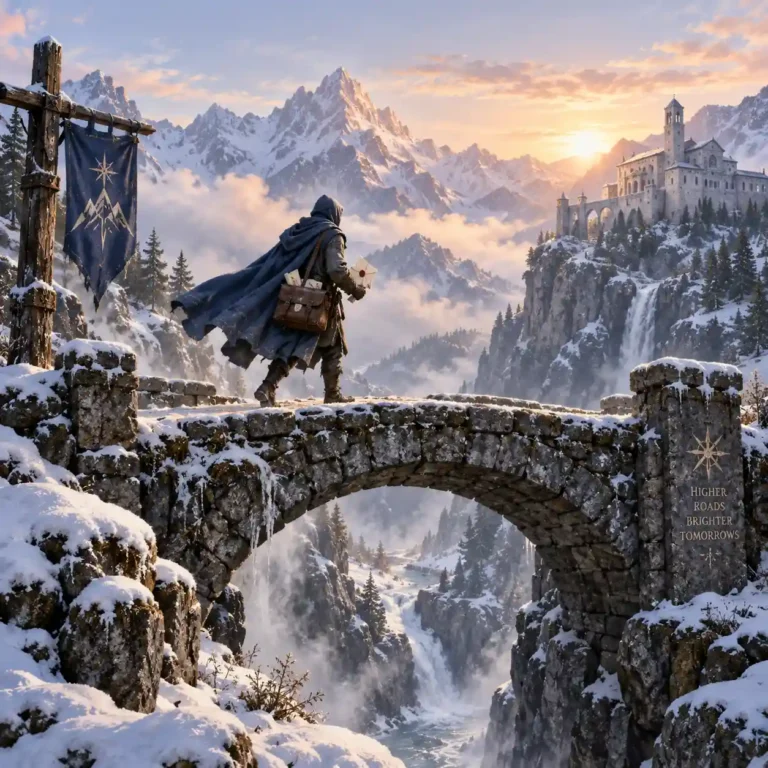
High Bell Pass links the orchard town of Dunmere to the silver workshops of Kestrel Hold. Each autumn, the pass warden inspects three exposed bends and sends a messenger to both towns. The warden announces a restricted season when heavy carts must use the south road, while light travelers may cross with a licensed guide during suitable weather. In severe conditions the pass gate closes entirely.
This year, a delivery of glass lenses for the mountain observatory is delayed. The lenses are fragile and expensive; the courier’s employer will not pay for the long valley detour. The guide offers a narrow crossing window, but the pass warden has noticed new cracks in a retaining wall. Meanwhile, a village below the pass needs the same guide to bring a midwife home before nightfall.
None of these people is automatically a villain. The courier wants to keep a promise, the guide needs winter income, the warden wants to prevent an accident, and the village needs help. Characters can negotiate a new delivery date, arrange safe storage at the waystation, seek another route, or spend time repairing the wall. Whatever they choose, the road remains a functioning part of the world.
A quick winter-road planning worksheet
- Connection: What two places does this road link, and what normally travels along it?
- Hazard: Which specific stretch becomes difficult, and under what conditions?
- Authority: Who warns, restricts, or closes the road?
- Alternative: What slower or more expensive route remains?
- Consequence: Which ordinary worker or household feels the disruption first?
- Decision: What can a character reasonably do besides waiting?
Frequently asked questions
Should every fantasy mountain pass close for winter?
No. Some routes remain usable with experienced guides and suitable conditions; others are routinely abandoned for a season. A real example of a pass with a seasonal closure is Switzerland’s Susten Pass. Treat that as an illustration, not a rule for every fictional mountain.
How can I write winter travel without tracking every mile?
Establish the route states, expected travel intervals, and the next meaningful decision point. Then summarize uneventful days. Spend scene time on the guide’s warning, a disputed toll, or the choice between a sheltered detour and an uncertain shortcut.
The key principle: winter does not merely slow a journey. It redistributes work, money, and responsibility. Build those consequences into the map and your setting will generate stories naturally.


3 Comments